

CMRA in the News
CMRA in the Press
Selected media coverage, published analysis, and expert perspectives featuring Capital Market Risk Advisors and its senior professionals.
A Data-Driven Guide for Navigating the 2026 Oil Price Shock
Peter Niculescu and Leslie Rahl examine commodity price volatility, derivatives, market risk, and the implications of the 2026 oil price shock.
Risk Management in 2020: How Gut Feelings Sniffed Out What Math Couldn't
CMRA emphasized the importance of risk-manager judgment when historical data and models lag fast-moving markets, particularly during the COVID-19 crisis.
Lehman, Citi Settle $2 Billion Financial Crisis-Era Dispute
Peter Niculescu commented on unresolved questions surrounding ISDA close-out valuation, bid-ask spreads, trade netting, and replacement costs.
New Margin Regulations for Non-Cleared Derivatives
Analysis of margin requirements for uncleared derivatives, including implementation challenges, collateral, and related risk implications.
Earlier Media Coverage Historical Coverage · 2009–1994
Ex-Fannie Executive Hired
Coverage of Peter Niculescu's professional transition following his leadership role at Fannie Mae.
In Modeling Risk, the Human Factor Was Left Out
Leslie Rahl discussed the limitations of financial models in capturing complexity, leverage, liquidity, and transparency risks.
CMRA-hosted archival copyWorst Crisis Since '30s, With No End Yet in Sight
Leslie Rahl discussed how credit default swaps contributed to financial-system stress during the 2008 crisis.
How Wall Street Lied to Its Computers
Leslie Rahl commented on the limitations of quantitative models and assumptions that can fail during extreme market conditions.
Up the Volga Without a Calculator: At This Point, Banks Can't Figure Their Exposure
Coverage of financial institutions struggling to quantify derivatives exposures and counterparty risk during the Russian financial crisis.
Orange County Didn't Know How Much Trouble…
Forbes described Leslie Rahl's work helping determine the true condition of Orange County's investment pool following its financial collapse.
CMRA-hosted press referenceBut No Cigar: How a Rescue Mission Failed, Just Barely, in Orange County
Historical reporting on CMRA's work assessing Orange County's complex investment portfolio and the unsuccessful effort to prevent its collapse.
CMRA-hosted archival copyMaking a Model
Grant's Interest Rate Observer compared CMRA's work in financial engineering to the crisis-response expertise of Red Adair in the oil and gas industry.
Original article link not suppliedHelpful Web Resources
Associations & Organizations
- Alternative Investment Management Association (AIMA)
- Managed Funds Association (MFA)
- Securities Industry and Financial Markets Association (SIFMA)
- Financial Accounting Standards Board (FASB)
- Financial Stability Board
- Global Association of Risk Professionals (GARP)
- Global Risk Institute (GRI)
- International Association for Quantitative Finance (IAQF)
- International Swaps and Derivatives Association (ISDA)
- P.R.I.M.E. Finance
- Professional Risk Manager’s International Association (PRMIA)
Derivatives
- BIS Semiannual derivatives statistics
- Volume data for over-the-counter derivatives
- ISDA SwapsInfo
- Visualize over-the-counter derivatives data
- OCC Quarterly Report on Bank Derivatives Activities
- Quarterly report on bank and bank holding company derivative activities
Periodicals
- Bloomberg Markets Magazine
- Euromoney
- Financial Times
- Matt Levine's Money Stuff
- A daily newsletter highlighting the latest news and developments in all things finance, delivered with a healthy dose of humor.
- The Wall Street Journal
Risk Management
- Federal Reserve Economic Data (FRED)
- NYU Stern Volatility Laboratory
- Research on risks in financial markets, with daily calculations of volatilities and correlations on a wide range of assets
- Risk.net
- Coverage of financial industry, with a focus on risk management, derivatives, and complex finance
Regulatory
- Commodity Futures Trading Commission (CFTC)
- Federal Deposit Insurance Corporation (FDIC)
- Federal Housing Finance Agency (FHFA)
- Federal Reserve Board (Fed)
- Financial Industry Regulatory Authority (FINRA)
- National Futures Association (NFA)
- Office of the Comptroller of the Currency (OCC)
- U.S. Securities and Exchange Commission (SEC)
Structured Finance
- Asset Securitization Report
- Coverage, analysis, and commentary on structured finance markets
- Structured Finance Industry Group
- Educational resources on structured finance and securitization
- The Journal of Structured Finance
- Quarterly academic journal on structuring and investing in structured finance.
CMRA Books
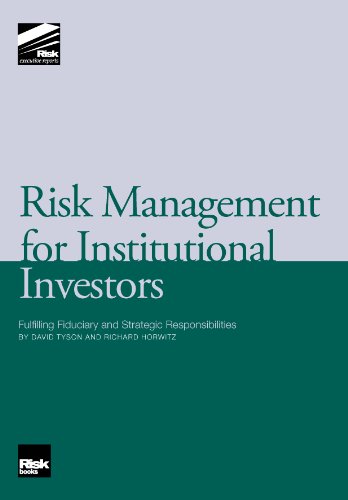
Risk Management for Institutional Investors:
Fulfilling Fiduciary and Strategic Responsibilities
By Richard Horwitz and David Tyson, Capital Market Risk Advisors; Published by Risk Books, Nov 2013
More about the book
Risk Management for Institutional Investors: Fulfilling Fiduciary and Strategic Responsibilities addresses how board members, directors, trustees, and members of the C-suite overseeing a pension or endowment fund can properly manage and mitigate risk. It details on a practical level how the necessary data can be collected and reported to this governing board within the broad framework of current risk management practices.
This holistic executive report will include discussions of risk appetite, risk governance, board risk communication, and board risk training, and will address how highly technical and granular data can be synthesized so that it can be reported to a board that may only meet for three hours every three months, in turn informing the decisions the institutional investors make.
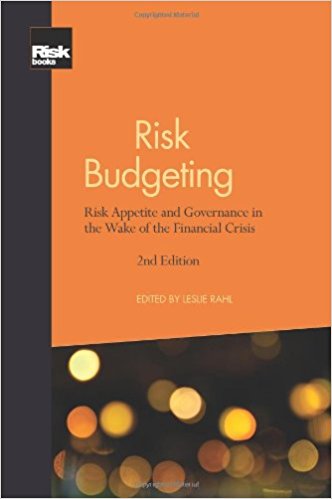
Risk Budgeting, Second Edition:
Risk Appetite and Governance in the Wake of the Financial Crisis
Edited by Leslie Rahl, Capital Market Risk Advisors
More about the book
- This fully updated and revised second edition of the best-selling guide Risk Budgeting expands upon the first edition, continuing to provide a road map for more effective risk allocation and better return per unit of risk taken. This edition reflects in particular the growing focus on risk appetite and governance in the risk budgeting environment.

Hedge Fund Transparency:
Unraveling the Complex and Controversial Debate
By Leslie Rahl, Capital Market Risk Advisors
More about the book
The only title that focuses solely on hedge fund transparency and offers a balanced perspective that appreciates both the needs of institutional investors and hedge fund managers.
Presents clear insight on why hedge fund transparency is an issue, as well as offers solutions
- Includes "perspectives" based on interviews with numerous eminent practitioners from both sides of the investor/hedge fund debate
- Service providers including consultants, prime brokers, third party marketers, capital introducers, systems providers, lawyers and accountants, will additionally acquire an enhanced insight into the needs of both investors and hedge funds in order to tailor their services to the market needs
- The press and the regulators can also achieve enhanced understanding of this complex and controversial subject
- Written by the best-selling author and practitioner Leslie Rahl, who is the chair of the Investor Risk Committee of the IAFE Committee on Hedge Fund
- Transparency and is uniquely placed to advise on and explain the issues for all concerned participants

Risk Budgeting
A New Approach to Investing
Edited by Leslie Rahl, Capital Market Risk Advisors; Published by Risk Books, November 2000
More about the book
A practical and authoritative introduction to the concept of risk unit allocation as an alternative and more effective decision-making process for long-term investors.
Make an informed decision about how to implement and execute a "risk unit allocation" investment policy
- Analysis of techniques to assess how risk might impact long-term Investment returns
- Introduces methods to allocate assets based on the "risk unit" exposures - in individual asset classes and on a portfolio basis, to meet long-term pension obligations and investment return objectives
- Investigates ways to use VAR to accommodate a long-term investment horizon
- Contributions from leading experts drawn from consultancies; large institutional investors; pension plans; investment banks and academia
- Leslie Rahl has donated her proceeds from the sale of the book to the Fischer Black Memorial Foundation.
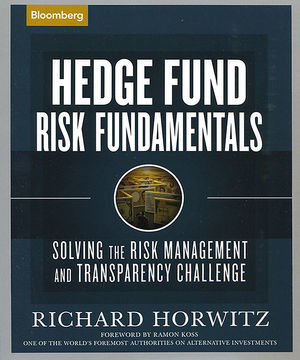
Hedge Fund Risk Fundamentals:
Solving the Risk Management and Transparency Challenge
By Richard Horwitz, Capital Market Risk Advisors
More about the book
In the constantly evolving hedge fund marketplace, nothing is more central--but in many ways, more amorphous and elusive--than risk. Yet there remains no standard for analyzing and measuring risk within this highly secretive, largely unregulated field, leaving the thousands of hedge funds--and the tens of thousands of hedge fund investors--in dangerously dim light. The industry has not solved the "transparency" challenge--communicating risk to investors without disclosing proprietary information.In the constantly evolving hedge fund marketplace, nothing is more central--but in many ways, more amorphous and elusive--than risk. Yet there remains no standard for analyzing and measuring risk within this highly secretive, largely unregulated field, leaving the thousands of hedge funds--and the tens of thousands of hedge fund investors--in dangerously dim light. The industry has not solved the "transparency" challenge--communicating risk to investors without disclosing proprietary information.
Hedge Fund Risk Fundamentals is the first book to bring these issues to the forefront. With clarity, concision, and minimal math, Richard Horwitz lays out the key components and the cutting-edge processes in the field of hedge fund risk management today. Against that backdrop, he presents a groundbreaking utility destined to set the standard for transparency and risk management within the hedge fund universe.
You’ll learn why, when it comes to risk management, 1 + 1 = 1.41. For all of those perplexed by the difficulties of assessing risk in hedge fund investing, Horwitz’s concepts make for an invaluable road map and a demystifying resource that hedge funds and investors at all levels will find indispensable.
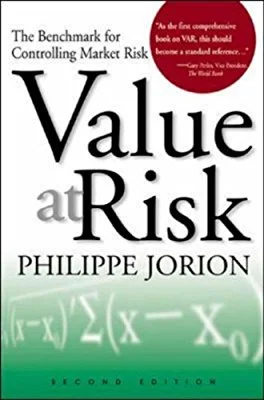
Value at Risk
"This book has become an industry standard for value at risk."
Leslie Rahl, president, CMRA
More about the book
- To accommodate sweeping global economic changes, the risk management field has evolved substantially since the first edition of Value at Risk, making this revised edition a must. Updates include a new chapter on liquidity risk, information on the latest risk instruments and the expanded derivatives market, recent developments in Monte Carlo methods, and more. Value at Risk, Second Edition, will help professional risk managers understand, and operate within, today's dynamic new risk environment.
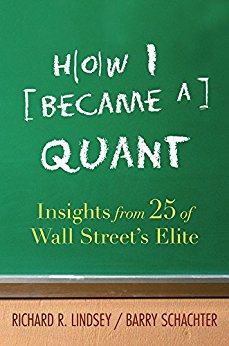
How I Became a Quant
By Richard R. Lindsey and Barry Schachter
From Amazon:
More about the book
"Quants"--those who design and implement mathematical models for the pricing of derivatives, assessment of risk, or prediction of market movements--are the backbone of today's investment industry. As the greater volatility of current financial markets has driven investors to seek shelter from increasing uncertainty, the quant revolution has given people the opportunity to avoid unwanted financial risk by literally trading it away, or more specifically, paying someone else to take on the unwanted risk.
How I Became a Quant reveals the faces behind the quant revolution, offering you the chance to learn firsthand what it's like to be a?quant today. In this fascinating collection of Wall Street war stories, more than two dozen quants detail their roots, roles, and contributions, explaining what they do and how they do it, as well as outlining the sometimes unexpected paths they have followed from the halls of academia to the front lines of an investment revolution.

Risk Management: The State of the Art
Edited by Stephen Figlewski and Richard M. Levich
More about the book
The articles in this volume examine the "State of the Art" in risk management from the standpoint of academic researchers, market analysts and practitioners, and government observers with
Risk Management: Where Are We Heading? Where Have We Been? Contributed by Leslie Rahl.
CMRA Research & Perspectives
Commentary & Analysis
Independent perspectives on derivatives, valuation, financial risk, and developments across global markets.
CMRA Comment Letter on Derivatives Tax & Economic Substance
CMRA examines the economic substance of derivatives transactions, including market risk, valuation, and realistic pretax profit potential. The analysis includes CMRA's regulatory comment letter.
AI Market Risk Joins CMRA's Galaxy of Risks™
Examining how autonomous AI can amplify market movements and introduce new challenges for risk governance and financial stability.
A Data-Driven Guide for Navigating the 2026 Oil Price Shock
Analysis of oil price volatility, derivatives valuation, and potential litigation arising from extreme market dislocations.
Earlier Commentary & Analysis 9 Articles · 2024–2017 ⌄
Emerging Risks
An unprecedented intraday VIX spike highlights the risks of extreme volatility and rapid market reversals.
Using the VIX to Distinguish between Transitory and Persistent Risk
Understanding how VIX futures and the volatility surface complement the VIX Index in assessing market risk.
Take a Close Look at Your Stress Test Assumptions
Rising implied volatility across VIX, MOVE and FX markets calls for renewed attention to stress scenarios and risk assumptions.
Say What You Do, and Do What You Say!
Peter Niculescu reflects on fiduciary responsibility, model assumptions, stress testing and liquidity risk in investment management.
Risk Management Lessons Learned in 2020 Covid Crisis
Insights from risk professionals on hypothetical stress scenarios, model validation, liquidity and the importance of informed judgment.
Asset Liquidity Risk: Piecing Together the Puzzle
CMRA examines asset liquidity, regulatory expectations and the difficulties of measuring liquidity risk across markets.
The Great (Disappearing) Recession: Adding Historical Data Desensitizes the Shock
How the passage of time can reduce the influence of the 2008–2009 financial crisis in historical stress-testing calculations.
CMRA's Uncleared Swap Margin Survey Results
Market participants share their perspectives on initial margin, variation margin, ISDA SIMM and the costs of compliance.
Are Your Pricing Policies and Procedures for Less Liquid Instruments Adequate? — The SEC Is Looking
Recommendations for stronger pricing governance, independent valuation controls, model validation and oversight of illiquid instruments.